
Nudge:The Casual Dating App
Matthew Peter NicholsonSocial
4.6105.00 Reviews
- Version
- 1.0.0
- Installs
- 10.00K
- Age Rating
- Mature 17+
Screenshots
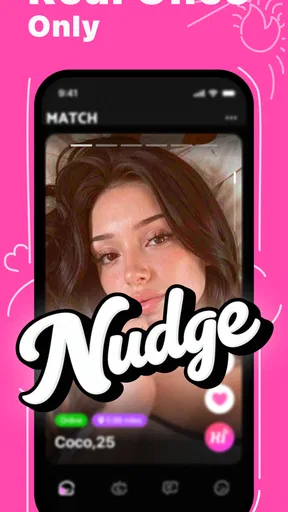



Our Review of Nudge:The Casual Dating App
 Analysis by Appyee
I approached Nudge as a social app for people who want to meet open-minded singles without treating every interaction like a formal dating interview. Its basic idea is easy to understand: connect with people who may be interested in dating or friendship, then decide whether a conversation is worth pursuing. In practice, the quality of the experience depends less on the swipe itself and more on how carefully you set up your profile, manage expectations, and move from a match to a real conversation.
That makes Nudge more useful for someone who wants a flexible way to meet people than for someone looking for a highly structured matchmaking service. I found the concept approachable, but the app also asks users to do some of the work themselves. A quick profile and random swiping may produce activity, yet a thoughtful setup gives you a much better chance of finding compatible people.
Getting started without creating avoidable problems
Nudge is free to download, and its social focus is clear from the beginning. It is designed for mature users, with a 17+ content rating, so it is not an app I would recommend treating as a casual space for younger users. The developer is Matthew Peter Nicholson, and the current release is version 1.0.0. That version detail matters because a new app can feel less polished in places than a long-established dating platform, especially when users have very different phones and connection conditions.
The first useful step is to decide what you actually want from the app. The store positioning allows for dating or friendship, and those are not the same goal. If your profile sounds romantic while you are mainly hoping to make friends, you may attract the wrong conversations. I would state the intended direction plainly and keep the wording friendly rather than trying to appeal to everyone.
Profile setup is also where many users create their own friction. A vague description gives a potential match very little to respond to, while an overloaded biography can feel like an application form. I would choose a few specific details that naturally invite a question: a weekend habit, a favorite kind of outing, or the sort of conversation you enjoy. The goal is not to reveal everything immediately; it is to make a first message easier.
Photos deserve the same practical attention. Use images that make it easy to recognize you and that represent your current appearance. A profile built from unclear, heavily edited, or group-only pictures creates uncertainty before anyone has even spoken. That uncertainty can lead to fewer replies and more cautious conversations, which may look like an app problem when the real issue is presentation.
The best setup is not the most detailed one; it is the one that makes your intentions and personality easy to understand. This is especially important in an app that leaves room for both friendship and dating. Clear expectations reduce awkward exchanges later and help you decide more quickly whether a match is worth your time.
Where a first session can feel stuck
The swipe-and-match format is familiar, but familiarity can be misleading. A match is only an opening, not evidence that two people will communicate well. If you expect every match to become an active conversation, Nudge may feel disappointing even when it is working normally. People may match impulsively, check the app at different times, or decide that the connection is not right after reading a profile more closely.
I would also avoid judging the app after only a short session. A social app needs enough relevant people in your area or preferred community to feel useful, and that can vary considerably by location. Someone in a large, active area may find more possibilities than someone browsing in a smaller one. That difference is not necessarily a technical failure, but it does affect the day-to-day experience.
Another common sticking point is the transition from matching to messaging. A simple greeting often gives the other person no clear way to respond. Instead of sending only “hi,” I would refer to something visible in the profile and ask an uncomplicated question. For example, if someone mentions a hobby, ask how they got into it rather than demanding a complete introduction. This creates a small conversational path instead of placing all the effort on the other person.
There is also a trade-off in the broad audience. Nudge can suit people who do not want to define themselves too narrowly, but that flexibility may bring conversations with different expectations. I would use the early messages to establish whether the other person wants friendship, dating, or simply casual conversation. Doing that politely is more efficient than continuing a chat that is clearly heading in a different direction.
Simple checks before blaming the application
If the app does not behave as expected, I would start with the basics rather than immediately assuming that an account or match has disappeared. Confirm that the phone has a stable internet connection, switch between Wi-Fi and mobile data if possible, and reopen the app. A temporary connection interruption can make a social feed feel empty or leave an action appearing unfinished.
It is also worth checking whether the phone meets the basic software requirement. Nudge supports Android 7.0 and later, so an older device may not provide the intended experience. Even on a compatible phone, limited storage, an outdated operating system, or too many background processes can make loading and scrolling feel unreliable. Closing unused apps and restarting the phone are simple steps, but they often separate a local device issue from an app-wide problem.
When a profile image or conversation seems slow to appear, give the connection a moment before repeating the same action. Tapping repeatedly can make it harder to tell whether the first request worked. I prefer to pause, leave the screen, and return once rather than creating several duplicate attempts. This is a small habit, but it helps prevent confusion when an interface is waiting on a slow network.
If the app opens but a particular action remains unavailable, check the surrounding context. A match may not mean that a full conversation has been established, and a profile may change because the other person has adjusted their account or is no longer available in the same way. I would avoid assuming that every change is a bug or that another user has deliberately ignored me.
Nudge has a 4.6 average from around 794 ratings, which suggests that many users find the overall experience worthwhile, but an average cannot predict how it will perform on every phone or in every location. The app has over 10K installs, so it is not an entirely untested idea, yet its relatively focused scale means your local experience may matter more than the headline rating.
Recovering a conversation or a stalled workflow
When a conversation loses momentum, I would first review the last message rather than sending several follow-ups. If the message required a detailed answer, sounded too intense, or arrived at an inconvenient time, silence may simply mean the exchange needs space. A short, low-pressure follow-up is more respectful than trying to force a response. If there is still no reply, moving on is usually the healthiest choice.
A useful workflow is to separate discovery from evaluation. During browsing, look for people whose stated interests and communication style seem compatible. After a match, slow down and read the profile again before writing. This second look often reveals whether the initial attraction was based on a real point of connection or only on a quick impression. It also helps you avoid sending a generic message that could have been written to anyone.
I would keep early conversations inside the app until the other person has shown consistent, respectful behavior. If you eventually decide to meet, arrange a public place, tell someone you trust where you will be, and keep your own transport or exit plan. Nudge can help two people discover one another, but it cannot replace ordinary judgment about identity, boundaries, and personal safety.
The same principle applies to requests for money, urgent favors, or private information. A friendly tone is not proof of trustworthiness. If someone pressures you to move quickly, refuses reasonable questions, or makes the conversation feel uncomfortable, ending the exchange and using the app’s available account controls is more sensible than trying to repair it.
For users considering paid options, the app is free but includes in-app purchases ranging from $3.99 to $99.99 per item. I would not spend money simply to compensate for a weak profile, an inactive local audience, or poor messaging habits. First establish that the free experience gives you relevant conversations. Paid tools, if you choose to use them, should solve a specific need rather than become a reaction to frustration.
When the problem is really the match, device, or expectation
It is easy to blame a dating app when the deeper issue is a mismatch between the service and the user’s goal. Nudge is a reasonable option for someone open to both dating and friendship, but it may not be the best choice for a person who wants carefully filtered compatibility questions, extensive relationship preferences, or a large, established community in every city.
If you prefer a platform centered almost entirely on long-term dating, a more specialized alternative may give you clearer signals. If you mainly want spontaneous local activities, a community or event-oriented service may be more suitable. Nudge sits between those uses: it encourages personal discovery, but it does not remove the need to explain yourself and choose carefully.
It may also be the wrong fit if you dislike ambiguity. The broad idea of meeting open-minded singles sounds welcoming, but it means users can arrive with different definitions of casual conversation, friendship, and dating. I would skip it if you need every interaction to begin with tightly defined intentions. On the other hand, that same openness is a strength for people who do not want to commit to one narrow label at the start.
Device behavior can distort your judgment too. If the app is slow only on one phone, crashes alongside other apps, or behaves differently after a restart, investigate the device before deciding that Nudge is unusable. If the same issue continues across a stable connection and a compatible device, documenting what happened and contacting the developer is more productive than repeatedly reinstalling without knowing what changed.
Privacy and comfort should guide how much you share. A profile can be informative without including your workplace, home area, daily schedule, or other details that make you easy to locate. I would also be cautious with photos that reveal private documents, addresses, or recognizable routines. These are not special rules for Nudge; they are particularly important in any service that connects you with people you do not yet know.
How I would use Nudge in an ordinary week
Imagine opening the app after work because you would like to meet someone for coffee, but you are also open to making a new friend. I would first update the profile so that both possibilities are clear, then browse slowly rather than treating the session like a race. I would save my attention for profiles with at least one genuine point of connection and send a message tied to that detail.
If a match replies, I would keep the first exchange light and specific. After a few messages, I would check whether the conversation feels balanced: are both people asking questions, respecting boundaries, and responding with reasonable effort? If yes, suggesting a short public meeting can be more useful than endless messaging. If not, I would end the conversation politely instead of trying to turn a weak match into a successful one.
This workflow highlights one of the app’s less obvious trade-offs. Nudge can make discovery feel informal, but informal does not mean effortless. The people who get the most from it are likely to be those willing to curate their profile, start conversations thoughtfully, and leave mismatched interactions behind. Users expecting the app to do all the filtering may find the experience tiring.
The app’s social category also means that success is personal rather than purely mechanical. One person may value a single promising conversation, while another may want a steady stream of matches. I would measure it by the quality and comfort of the interactions, not just by how many profiles appear or how quickly someone responds.
My practical verdict on Nudge
I see Nudge as a straightforward option for mature users who want a less rigid route into dating or friendship. Its appeal comes from flexibility: you can approach it with romantic interest, social curiosity, or a mixture of both. That makes it approachable, but it also places responsibility on you to communicate clearly and recognize when another person’s expectations differ from yours.
The free entry point makes it easy to test without committing immediately, while the paid items deserve restraint because they can cost from $3.99 up to $99.99 each. I would use the free experience first, improve the profile, and see whether the local community feels active. Paying before answering those questions would be putting money behind an uncertainty that better setup may not fix.
My main reservation is not the concept; it is the amount of user judgment the concept requires. Nudge cannot guarantee that a match will reply, that a profile is authentic, or that two people want the same kind of connection. Those limitations are common in social dating apps, but they matter more when the service keeps the experience broad and informal.
For someone who wants a relaxed way to meet open-minded singles and is comfortable taking an active role, I think Nudge is worth trying. For someone seeking extensive compatibility tools, a very large established network, or highly predictable intentions, another category of app may be a better fit. I would recommend Nudge as a starting point for genuine conversations, not as a shortcut around the work of choosing people carefully.
Verdict
Strengths of Nudge:The Casual Dating App
- Simple swipe-based interface makes browsing profiles quick and easy.
- Focused on casual connections, reducing pressure for serious commitment.
- Profile prompts can help users start conversations more naturally.
- Location-based discovery helps find people nearby.
- Free download lets users explore the basic experience before paying.
Limitations of Nudge:The Casual Dating App
- Smaller user pool may limit matches outside major cities.
- Some features may require a subscription or in-app purchases.
- Casual dating focus may not suit users seeking long-term relationships.
- Profile quality can vary, making intentions difficult to judge.
- Frequent notifications may feel distracting or overly promotional.
Similar Picks in This Category
View All
Meta Platforms, Inc.4.6

Instagram4.0

Likee-Live, Chat & Party Games
Likeme Pte. Ltd.4.4

Facebook Lite
Meta Platforms, Inc.4.5

TikTok - Videos, Shop & LIVE
TikTok Pte. Ltd.4.0

Moj: Free Short Drama & Reels
ShareChat4.1
Frequently Asked Questions
What is Nudge: The Casual Dating App?
Nudge: The Casual Dating App is designed for people who want a more relaxed way to meet and chat with potential matches. Instead of making the experience feel overly formal, the app focuses on casual interactions, discovery, and starting conversations. Its usefulness depends on the number of active users in your area, so results may vary by location and age group.
Is Nudge: The Casual Dating App free to download and use?
The app may be available to download at no initial cost, but some features can require in-app purchases or a subscription. Depending on the current version, premium options may include enhanced visibility, additional interaction tools, or other conveniences. Before confirming a payment, review the pricing, renewal terms, and cancellation instructions shown in the app store or within the application.
Is Nudge suitable for serious relationships or only casual dating?
Nudge is primarily presented as a casual dating platform, making it suitable for users who prefer low-pressure conversations and flexible expectations. However, people may use dating apps with different goals, and some users could still be interested in a long-term relationship. It is best to communicate your intentions clearly and confirm that a match is looking for the same type of connection.
How can I stay safe while using Nudge?
Use the same precautions you would follow on any dating service. Avoid sharing your home address, financial information, passwords, or sensitive personal details with someone you have just met. Keep early conversations inside the app, be cautious of requests for money, and report suspicious accounts. If you arrange a meeting, choose a busy public place and tell a trusted person where you will be.
What should I check before downloading Nudge: The Casual Dating App?
Before downloading, check whether the app is officially available in your country and compatible with your Android or iOS device. Read the current privacy policy, permissions, age requirements, subscription details, and recent user reviews. You should also confirm whether the app has enough active members near you, since a smaller local user base can significantly affect the quality and number of potential matches.
